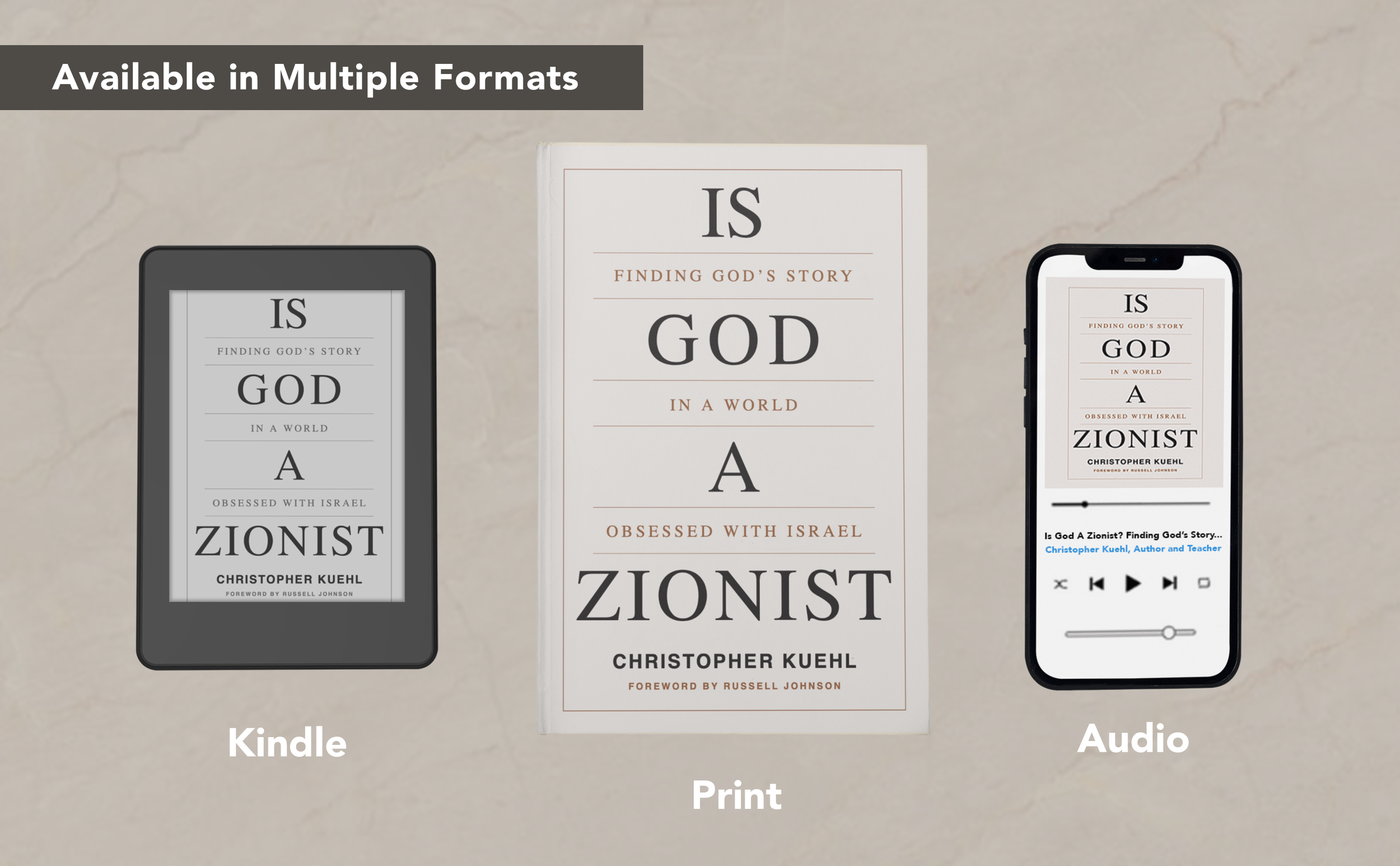
Title: IS God A Zionist

SubTitle: Finding God’s Story In A World Obsessed With Israel

Release Date: Mid-February

Download Press Kit

Book Summary: The Church has an Israel problem, or more bluntly, a "what do we do about Israel" dilemma. In a world obsessed with Israel, amid endless wars, boycotts, and Jewish conspiracy, this dilemma is not vanishing anytime soon. As Christians, do we share some responsibility in answering these questions for the world? In "Is God a Zionist?", Christopher Kuehl delivers a provocative Christian apologetic that affirms God's unbreakable covenant with the Jewish people: land, descendants, and all. Written for anyone grappling with today's cultural chaos, this book is your raw invitation to find your stand in this spiritual war. Kuehl weaves Church history's giants—from Augustine, to Spurgeon, to Vatican II—right into pop culture firestorms involving Kanye, Candace Owens, and Tucker Carlson. Divided into three parts, it dissects the Jewish-Christian divorce, builds a biblical case for Israel's eternal promises, and lastly enters into the conflict raging across the internet. This book is part memoir, part theology, but 100% common sense that integrates Biblical truth into cultural moment. Come wrestle with a restorationist God who resurrects nations, defies all human reason, and promises "life from the dead" when Israel sees their Messiah.

What People Are Saying

“"A plea for sanity, discernment, and common sense regarding Israel”

Johnny Enlow author, The Book of Enoch Commentary & Kingdom Come 

“This work’s rhetoric offers a brisk intake of clarity. In an arena of shallow thinking, close handed dogmatism and half hearted ecumenism, we are here invited away from the bustling metropolis of reaction to the secret places in the desert of reflection.”

Matthew VanNorstran, ThM, Princeton Seminary & Dean of Theos Seminary 

“In his inaugural book, “Is God a Zionist”, author Chris Kuehl, asks and answers one of the most important questions facing the Church today. He does so from ground zero, personal experience with the people in the Land, and from thirty thousand feet, insights of influencers and theologians throughout the ages, shared with clarity and simplicity. The title asks the question. The contents answer it. A must read!”

John Myers, Founding Pastor of Shemen Sasson, Jerusalem & The Israel Story

“Reading Christopher Kuehl’s work, I felt something rare in our current moment: clarity. Not Twitter-thread clarity. Not soundbite clarity. Biblical, historical, and philosophical clarity. This book is not a partisan pamphlet. It is a sustained argument that stretches from the deserts of the Ancient Near East to the streets of modern Jerusalem, from the prophets of Israel to the Apostle Paul, from the Church Fathers to our chaotic digital age.”

Russell Johnson, Pastor & Founder of Pursuit NW

“Is Christian Zionism a brain virus? Is the Church the New Israel? This book is a great place to start examining these questions. It is easy to read, informed by good scholarship, and tackles every tough question.”

Gerald McDermott, author, A New History of Redemption: The Work of Jesus the Messiah Through the Millennia (Baker Academic) & A New Christian Zionism (IVP Academic)

Table of Contents:

  • Introduction

  • A Note To the Reader

  • Section I: A Brief History

  • Chapter 1: The Parting of the Ways: The Jewish Response

  • Chapter 2: The Parting of the Ways: The Christian Response

  • Section II: A Biblical Case For Israel

  • Chapter 3: Fulfillment Theology & The Worst Rebrand Ever

  • Chapter 4: When God Makes A Blood Oath

  • Chapter 5: Beloved Enemies & Irrevocable Promises

  • Chapter 6: Land Belongs To The Living

  • Chapter 7: Will The Real Israel Please Stand Up?

  • Chapter 8: The Tyranny of Ignorance

  • Chapter 9: The Hidden Face of God & The Everlasting Jew

  • Section III: Modern Implications

  • Chapter 10: When Tucker Carlson, Dispensationalism, and Christian Zionism Collide

  • Chapter 11: Colonizer! Apartheid! Genocide! Oh,My!

  • Chapter 12: Become The Christian Zionist Candace Owens Warned You About

  • Chapter 13: On The So Called “Jewish Question” & The Ultimate Reversal of Fortune

  • Chapter 14: The Heart of a People

Book Introduction 

I never set out to defend Israel or the Jewish people. My connection to Israel seemed purely accidental. 

I experienced a radical heart shift in 2000 that wonderfully sealed my focus on the kingdom of God. The hound of heaven found a way into my broken heart and redirected the trajectory of my life. A few years later, I graduated from a university with an accounting and finance degree. My goal was to work on Wall Street.

But I felt the Lord prompting me to let go of that and look elsewhere, at least for a time. The idea of hearing God might make some people uneasy, depending on their background, and that’s okay. But I was doing my best to submit to him and go wherever I believed he was leading, and that kickstarted a nine-month journey of actively seeking him—sometimes in hilariously zealous and ridiculous ways. 

I’m thankful that God knows what to do with our searching and is faithful to those who earnestly seek him, even when our search seems crazy. There’s purity in total submission to God, even if the rest of the world thinks it’s absurd. And it did seem absurd; I had zero ideas about what to do with my life once I handed over my dreams to him. 

At the end of this nine-month journey of letting go of my dreams of Wall Street—during which I worked nights at the post office while constantly praying and fasting about what to do with my life—I felt the Lord release me. At 23, I would have gone anywhere that didn’t involve working nights at the post office. I’d have been happy spinning a globe and going wherever my finger landed, or throwing darts at a map, hoping for something to stick.

So I applied to five different Christian organizations in mission-related work. Four of the five didn’t even respond to my application, further bruising my already-bruised ego. The only organization that accepted my application was based in Jerusalem. 

I was fine with that—not because I was a Zionist or had any stance on the Israeli/Palestinian conflict, or had a theological agenda or a point to prove. All I had was a deep desire to follow the Lord, and it led to a fourteen-month move to Jerusalem.

During that time, I witnessed a worship event that included messianic Jews and Christian Palestinians. I was amazed at how Jesus could unite these groups. Maybe I shouldn’t have been surprised—issues in Israel have deep theological undertones that can only be solved by profound spiritual truths—but seeing these diverse believers worshiping together was eye-opening. 

That evening, sitting in my apartment that overlooked Jerusalem’s Old City, I reflected on the power of the gospel to bring Jews and Palestinians together. As I was processing the beauty of God and his ability to create a bridge between these two groups, a clear voice struck my spirit: “The bridge I’m creating between Jews and Palestinians is nothing compared to the bridge I’m building between Christians and Jews.” 

At the time, I had no idea what these words meant. I couldn’t have told you the first thing about the church’s long history with the Jews. I had no reference point for the various theological positions on the nature of Israel and the church. Media attention and accusations against Israel and Jews weren’t circling around then to the degree they are now. I was simply a hungry heart seeking the Lord.

All I can say is that these words have never left my heart.

I’ve been back to Israel about fifteen times since 2007. I’ve had the privilege of seeing the whole country, the West Bank, Gaza, and many surrounding countries. I have both Jewish and Palestinian friends. I’ve played Shesh Besh (backgammon) with Arabs and lived with Bedouins—nomadic Arabs who live in tents throughout Israel. I’ve drunk coffee with the Druze and have celebrated with Jews. There’s nothing monolithic or simple about Israel. It’s dynamic, complex, and deeply human amid all the chaos.

It’s a real challenge to understand Israel in the age of the internet, which feeds us sound bites and oversimplifications of complex, nuanced issues. Israel defies oversimplification. Its history spans thousands of years. To wrestle with Israel, you’ll need to be willing to wrestle with God. It’s the main stage of history, a pressure cooker always about to blow, a heavy stone that cuts anyone who tries to carry it.

So I won’t be trying to carry it all. But I will try to explain some things. As I’ve matured out of 23-year-old zeal, I’ve been forced at times to grapple deeply with my understanding of Israel and the Jewish people. I’m currently finishing a master’s degree in theology because I want to explore the depths of these issues. I love theology, but I recognize that it’s often used to crush people rather than heal them. It can be a means to know God better, but it can also engender intellectual pride. At its best, it helps us understand the truth more fully. 

In the coming pages, I’ll weave my personal story into the story of Israel, hopefully bringing life to its complex issues and humanizing intellectual and theoretical positions that often come across as impersonal. I’ll address numerous theological topics, with the understanding that even a multitude of books can’t cover them exhaustively. 

I’ve found the heart of God in this story. I hope you do too.

Why Should You Care About This Topic? 

I’m constantly surprised by the attention Israel and Jewish people get. I should stop being surprised; God intentionally draws attention to things the world needs to observe. But whether it’s Joe Rogan, Kanye West, Candace Owens, Jordan Peterson, Tucker Carlson, screaming Stew Peters about to have an aneurysm, or hundreds of other names I could mention, it seems as if everyone wants to talk about Jews and Israel. The discussion is often about the Palestinian issue, often about some conspiracy theory (like Jews controlling the world), and often intertwined with scripture taken out of context. In the vast majority of cases, the conversation isn’t very positive toward Israel and Jews.

I read some of the top comments on these issues just to keep up with the conversation, but it’s shocking how often they express positive support for the “Austrian painter”—the psychopathic, genocidal, Jew-hating Hitler. When the open Hitler supporter Nick Fuentes delivers an unchallenged two hour interview with Tucker Carlson, that tells me we’re at an inflection point, revisiting the age-old scapegoating of Jews for the problems of the world. This is not at all a new phenomenon.

Perhaps you’ve been influenced by these ideas. You may believe nothing good comes out of Israel or the Jewish people. Or maybe you’re just tired of the conflict in the Middle East or the influence Israel advocates like AIPAC have on the U.S. You may be opposed to hearing about anything that isn’t “America first” or doesn’t seem to be directly related to U.S. interests. 

On the other hand, maybe you come from a Christian denomination or perspective that supports Israel and are looking for grounded explanations for your position. Or, from another Christian perspective that emphasizes covenant theology—which usually implies that the church has replaced Israel as God’s chosen people—you wonder why many people are still talking about Israel as integral to God’s purposes. 

Or maybe you’re just undecided on all of this.

That’s fine. We’ll address all of these perspectives in the following pages. The church has been talking about Jews for nearly two millennia, and that discussion is not going to end. Christianity is uniquely influenced by the Jewish people and therefore uniquely cornered by the Jewish question. The Christian faith didn’t spring out of Hinduism, Buddhism, Islam, or any other religion. Its origins are squarely set in the Jewish world. Its scriptures are authored entirely by Jews, with the possible exception of Luke and Acts. The Christian Messiah was Jewish. We’ve always had discussions about this spiritual heritage, and the connections between Christianity and Israel became even more critical and relevant with the return of Jews to Israel in 1948. The church has always had a role to play in this story. For anyone who identifies as a Christian, that’s important.

But this story reveals fundamental truths about God and our world. When we talk about Jews and Jewish history, we’re necessarily talking about God. And there lies the heart of the issue. 

A Word to Non-Zionists and Zionism Skeptics

I know how difficult it can be to listen to people you disagree with and who argue against your position, but the willingness to listen honestly and sincerely to understand another view is a hallmark of maturity and willpower. Most of us fail at that often, defaulting to defensive reactions easily. Decent people genuinely see things differently, and we need to be able to work through that tension. As Arthur said, “The test of tolerance is where men combat for truth but honor persons.” I’m sincerely inviting you on a journey of asking hard questions and reasoning together.

You need to know up front that I’m not a dispensationalist. If you aren’t familiar with that term, don’t worry; we’ll dive deeper into it in a later chapter. Or, if you’ve seen it discussed online, you may have read that any Christian who supports Israel must hold a dispensational position—a straw man argument I aim to dispel along with other inaccurate claims. I’ll draw from a variety of Christian sources and schools of thought throughout this book—I find much to appreciate in many of them, including Roman Catholic and Orthodox traditions—but my goal is not to promote any particular denomination or tradition. I want to look at the “voice of many waters” in the history of the glorious church. 

Because that church is filled with human beings, it displays all the difficulties, complexities, and faults humans come with. Yet, through the grace of God, it marches forward to transform the world. My goal is to pull from various Christian faith traditions to offer an apologetic that someone from any denomination can use.

Though the discussion in this book involves major theological concepts and much historical background, and therefore refers to many academic sources, I hope to keep a conversational tone, and I think you’ll see the relevance to society’s ongoing—and often fierce—debate. I’m offering a synthesis of our cultural moment and the biblical truth that informs it. I want anyone trying to navigate their way through these questions to be able to benefit from it.

I’ll share a perspective in this book that sees God’s hand orchestrating much of what is happening in the world right now—not with an “end times” focus but with awareness of history and the revelation of his purposes. God tells a story in scripture, and it’s marked by his faithfulness. The story has highs and lows and is messy and complicated, but it’s also deeply human and profoundly spiritual, and highly relevant to our times. 

The Spiritual Nature of Our Cultural Moment

There has been a dramatic increase in antisemitism in the last few years, and if you’ve been online at all, you’ve seen the accusations being leveled at Jews. It’s happening everywhere. This anti-Jewish energy is like an omnipresent magnet drawing the world’s focus to it. If you feel any sense of disgust or hatred toward Jews right now, it’s worth asking if you’ve been caught up in the riptide of this movement. It’s also important to recognize that there’s a spiritual reality behind everything in our world.

The brilliant Orthodox Christian cultural commentator Jonathan Pageau described this moment well while discussing Kanye West’s song “Heil Hitler.” The meta-story spinning in the world right now, he says, centers around the Jews. It’s being fueled by Arabs and Arab nations, Christians, the alt-right conspiracy crowd, social justice people on the left, and a variety of other cultural commentators. Nearly everyone has something to say about it and is therefore compounding the focus and energy behind it. Ironically, even those who openly hate Jews are giving a massive amount of airtime to the Jewish people.

Because this energy is, in most cases, not spiritually informed, it’s a negative take on God’s story. People are trying to look at spiritual realities with worldly eyes, which is a lot like watching The Matrix without understanding what you’re seeing. They’ve taken the blue pill and are still trying to grasp what the Matrix means. Or, like Edmund in Narnia, they’ve fallen through the wardrobe and are confused about reality. Pageau’s point is that the story currently running the world isn’t being properly integrated into our personal stories, and there will be horrifying consequences. 

I agree completely, but I also wonder if this story running the world is part of God’s design. Is the energy behind all of the antisemitism, anti-Zionism, accusations, and talk of conspiracies part of God’s story? He doesn’t endorse all of this hatred and spiritual confusion, of course, but he has a way of redirecting everything into his plans. He’s thrifty. With him, nothing goes to waste. I can see him using this story, which really began with Abraham, to draw the world’s attention to a specific focus point. Like a top that spins faster and faster, people’s eyes are drawn to it. There has to be a purpose in that. 

As believers in Jesus, we have an obligation to highlight the spiritual substructure of our world, its fundamental reality. As salt and light, we need to understand that our battle is not with flesh and blood but with darkness and spiritual powers in high places. There’s an ancient, diabolical spiritual hatred against Jews, like a mist covering the earth and enchanting people toward its own ends. As Christians, we need to find the story God is telling and not get caught up in any other.

That doesn’t mean we must love everything Israel, its leaders, or its advocates say or do. It also doesn’t mean we should hate Palestinians or not be heartbroken over war and death. Christians should love both Palestinians and Jews. But we can still recognize that a dark story is at work in the world right now, and it’s important to be aware of it and ask ourselves if we’ve been caught up in it. Increasing numbers of people are under a heavy delusion they call being “awake.” As Christians, we’re called to break spiritual darkness by being God’s conduits for light. 

There are two kinds of stories at work in the world: God’s story and any story that stands against it. At this cultural moment, even haters who oppose God’s story are contributing their energy and focus to it. God may even be leveraging them for that purpose. As Psalm 2 tells us, the nations rage, but God laughs.

This book is an invitation to step into God’s story.

A Note to Readers

I’ve written this book to provide a broad audience with a basic understanding of its topics in processing questions about Israel. In reality, each chapter could fill an entire book on its own. I’ve had to oversimplify complex subjects and make hard choices about what to include. My overarching goal is to offer a perspective on Israel that focuses on three themes: the split between Judaism and Christianity and how it occurred; a basic, non-dispensational theology of Israel that avoids the pitfalls of replacement theology; and a synthesis of how this worldview relates to modern issues.

Each chapter begins with a personal story about Israel, which I hope will humanize both Israelis and Palestinians in a non-theological way—an approach often missing in today’s conversation. Then I’ll provide a brief introduction to the chapter’s content. The main content of the chapter will follow. 

For some readers, chapters 4-6 may seem theologically dense. If that doesn’t interest you, I encourage you simply to read the chapter context and summary sections and move on. The chapters are logically ordered but not heavily interdependent, so you can skip around and focus on your main areas of interest, if you like. But if I’ve done my job well, this book should be accessible to a wide variety of readers, and, I hope, engaging enough to read from start to finish.